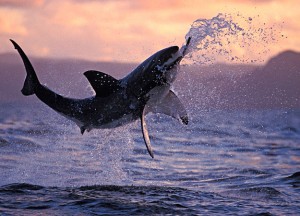
If you were around in 1975 this is the image that struck fear into the hearts of ocean lovers, swimmers, surfers and maybe just people in general.

JAWS was a box office hit and Steven Spielberg brought to life the monster from Peter Benchley's novel that made us all think twice before diving into the ocean.
Heck, I still think a bit before dipping my toes in the water and I live where there is freshwater! :)
However as scary as they may seem and as dangerous as they may be they need our help.
We enter their world, we know that they are there and we know that there
is always a potential that we could be attacked. I believe that it is no different than entering a forest or desert knowing that there are bears, snakes, lions and tigers (on my) that could potentially do as much damage as a shark but yet we have taken it upon ourselves as humans to seek and destroy these amazing creatures.
It is no secret that I love sharks, as does my son.
There is so much beauty and grace, yet power and danger with them.
They are clever hunters and the Great Whites have been known to jump straight out of the water in order to capture their prey.
For World Ocean's Day this year I would like to tell you a bit about the Great White shark and
what is happening to the species, why they are important for our oceans and what it being done to help save these beautiful creatures.
With the release of Jaws decades ago people have sought to destroy the Great White shark for fear of the shark intruding into our waters and attacks that could possibly happen to humans.
I get it, I really do, no one wants to be eaten alive but we also need to be aware that over the recent years there have been an average of 60 GWS attacks a year out of which 15-20% proved fatal.
Yes I know, tell these odds to someone who has been attacked, but perhaps they don't blame the shark for doing what is natural to them?
Great Whites often mistake humans for their natural prey, the seal. Often they will "test bite" their prey but unfortunately their "nibble" is a bit more due to their razor sharp teeth.
They were also overly fished for decades for the use of their fins, jaws and teeth and killed by the thousands just for the sport.
Scientists believe that females sharks will begin to reproduce at about the age of 10 and the average liter size is around 2-11.
A very slow pace as compared to the rate that they were being killed.
As of today, they estimate only a few thousand GWS left in worlds oceans.

Great White sharks are the top of the food chain in the ocean and destroying them would create a great imbalance to the system. They help create that balance and the health of the ecosystem by preying on species that are sick or weak, which helps the fish and marine mammal population stay healthy. If the GWS disappeared from the waters the ecosystem would lose control and over time destroy the delicate balance in the underwater environment.
In recent years scientists, Marine Biologists and those that wanted to know more about these great creatures began to study their behavior, their patterns, and their habitat in order to gain understanding as to what makes them tick.

I love the photo above. I first saw this image/film during The Discovery Channels Shark Week last year and thought that I would share it with you.
This is photographer Thomas P. Peschak
Here is what he had to say about his experience:
"To capture this image I tied myself to the tower of the research boat Lamnidae and leaned into the void, precariously hanging over the ocean while waiting patiently for a white shark to come along. I wanted to shot a photograph that would tell the story of our research efforts to track white sharks using kayaks. When the first shark of the day came across our sea kayak it dove to the seabed and inspected it from below. I quickly trained my camera on the dark shadow which slowly transformed from diffuse shape into the sleek outline of a large great white. When the shark’s dorsal fin broke the surface I thought I had the shot, but hesitated a fraction of a second and was rewarded with marine biologist Trey Snow in the kayak turning around to look behind him. I pressed the shutter and the rest was history. Throughout the day I shot many more images, most showing the kayak following the shark, but all lacked the power of that first image of the great white tracking the kayak."

"White sharks, despite their bad reputation are much more cautious and inquisitive in nature than aggressive and unpredictable. At no time have we ever had a shark show any agression towards our little yum yum yellow craft. So after some more testing we were soon able to make observations safely from up close and with as little interference as possible."
I can't say that this would scare the your know what out of me, but what an amazing experience!!
Right now there is a legislation in California to ban the sale of shark fins. At the same time Washington and Oregon are working towards a similar goal. Guam and Hawaii have also passed their own legislation by banning such sales. This is just a step and their is still so much to do to help preserve the population of GWS.
There is so much to be learned about the Great White Shark as well as other sharks that inhabit the oceans and while I think about the potential danger that awaits as I step into the ocean I also know that we are entering THEIR world and the more knowledge that we can gain the better we can not only protect ourselves, but the creatures that inhabit the great ecosystem that make up our oceans.
Information came from links below, please check them out if you are interested in learning a bit more.
If you are interested in helping out you can visit the World Wildlife Federation to find out how.
HAPPY WORLD OCEANS DAY!
I am linking up with
Shell Belles Tiki Hut today, come see what others are doing to help preserve the oceans and the amazing creatures that inhabit them.
And please visit Simone at Doberman's by the Sea for some more information and giveaways.


 Posts
Posts